


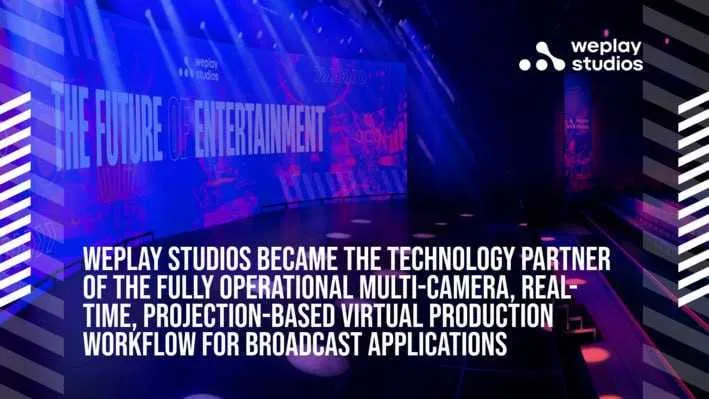
In collaboration with CarbonBlack Technology, Christie, Vizrt, HP, and Illumination Dynamics, WePlay Studios brought together a complete, production-ready ecosystem, showcasing that projection-based virtual production can support true multi-camera broadcast workflows while democratising production and making it significantly more accessible.
WePlay Studios, a California-based production company, is responsible for the full ICVFX system architecture, enabling simultaneous rendering of multiple independently tracked camera perspectives. The team led end-to-end system integration, including the assembly of render nodes based on HP Z workstations equipped with NVIDIA GPUs, AJA and Matrox video I/O, and a custom-engineered pipeline built on Vizrt technology, with visual design by Openset, specifically optimised for projection-based virtual production.
In addition, WePlay Studios delivered the complete broadcast infrastructure, including signal routing and distribution, subject lighting integration, and precise synchronisation across all system components. Additional partners contributed cameras, lenses, tracking systems, lighting fixtures, genlock synchronisation, and supporting technologies required to complete the workflow.
CarbonBlack Technology provides its nanotechnology-based Hybrid RP surface, delivering deep blacks, stable colour reproduction across the Rec. BT.2020 gamut, controlled light behaviour, and seamless, pixel-free imagery without moiré artefacts. The result is a cinematic, natural visual response that integrates convincingly with live subjects.
Christie supplies the high-frame-rate projection system, operating at up to 480 fps, enabling FrameMix-based multi-camera rendering with high colour accuracy.
Vizrt contributes Viz Engine 5 as the core real-time rendering and compositing backbone. Within this workflow, Viz Engine 5 enables low-latency integration of photorealistic environments with data-driven broadcast graphics, supporting chroma compositing where required and allowing operators to combine multiple rendering paradigms within a unified, production-ready pipeline.
“This solution is designed as a cost-efficient alternative to LED volumes for multi-camera broadcast workflows. It reduces power consumption by approximately 70 percent compared to LED-based systems, while providing a more natural lighting environment without high-intensity LED emission impacting on-set conditions. Chroma key-based production has been a foundation of broadcast workflows for decades, and now is the time to evolve it - building on generations of television production experience and advancing it into a fully integrated real-time environment,” comments Aleksii Gutiantov, Head of Virtual Production at WePlay Studios.
The integration and delivery of the system is part of the NAB Show demonstration, taking place April 19-22 at the Las Vegas Convention Center, booth CL3.